Find the Right AI Opportunities Before You Spend on the Wrong Ones.
We evaluate how your company actually works, identify and prioritize the strongest opportunities for AI and automation, and give you a practical roadmap for what to do next.
$999 fixed assessment • Remote or on-site

$999 Fixed Price
Know the assessment cost before we begin.
Remote or On-Site
Multiple structured interviews or a full manufacturing-site assessment.
Money-Back Guarantee
The assessment is backed by the Step Next Training guarantee.
Your Assessment. Your Choice.
We can evaluate your company remotely through structured interviews with your leadership and subject matter experts, or Kevin can come on-site and see the processes firsthand.
Structured interviews. Real processes. No travel required.
Multiple structured interviews with leadership, process owners, and SMEs. We examine the workflows, systems, bottlenecks, repetitive work, handoffs, and opportunities across the areas being assessed.
See the work where the work happens.
Kevin visits your manufacturing operation, talks directly with the people doing the work, observes the processes, reviews the systems and handoffs, and identifies opportunities that may not surface in executive interviews alone.
Clarity About What to Do Next.
The assessment is designed to give leadership a practical view of where the strongest opportunities exist, what should be addressed first, and what the next step should be.
Prioritized Opportunities
A ranked view of where AI, automation, data, or process improvement could create the most value.
Current-State Findings
The major bottlenecks, manual work, handoffs, process weaknesses, and constraints identified during the assessment.
Recommended Starting Point
A clear recommendation for the first process or opportunity worth addressing—and why.
Executive Roadmap
Clear next steps for what to implement, investigate, train around, improve internally, or deliberately leave alone.
The goal isn’t to find somewhere to use AI. The goal is to determine what your business should improve—and whether AI belongs in the solution.
Not Just Findings. A Recommended Solution.
We don’t stop at identifying problems. Your assessment connects the business problem to a practical recommended next step—whether that’s process improvement, conventional automation, AI, an n8n workflow, training, or a combination of them.
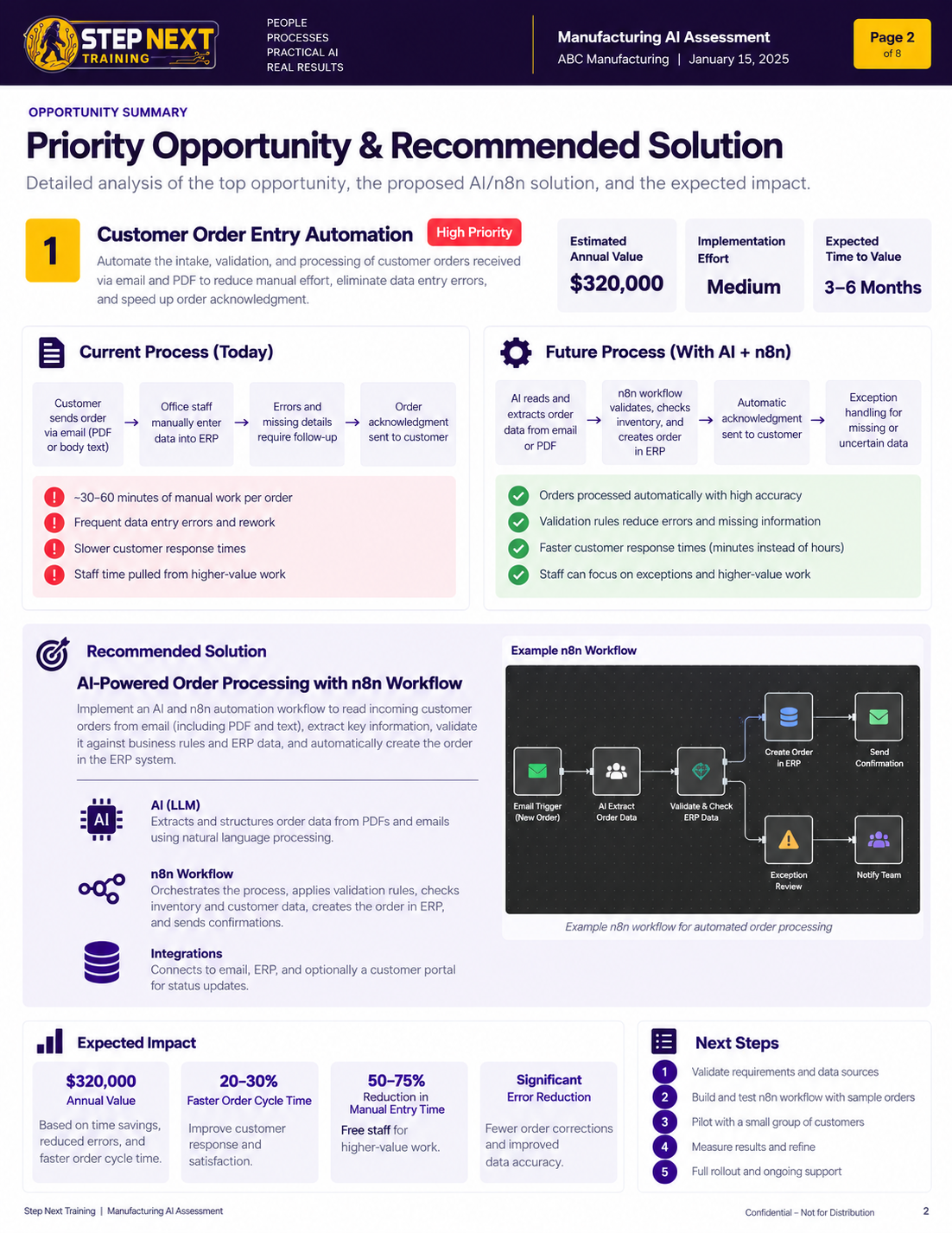
Illustrative example. Actual findings and recommendations are based on your company’s processes, data, systems, constraints, and business priorities.
From Business Problem to Buildable Solution
The assessment is designed to move beyond “here are some places you could use AI.” We identify the process problem, establish the current state, determine the cause, estimate the opportunity, and recommend what should actually change.
The Problem
What is happening today, where the process breaks down, and what it is costing the business.
The Opportunity
The potential business value, priority, implementation effort, and expected impact.
The Better Process
What the future workflow should look like before deciding which technology belongs in it.
The Recommended Solution
The specific combination of process changes, AI tools, automation, n8n workflows, integrations, or training we recommend.
The Next Step
A practical path to prototype, test, measure, and—if it works—implement the improvement.
AI is not automatically the answer. If AI isn’t the right solution, we’ll tell you. The recommendation should fit the process—not force the process to fit an AI tool.
What Could This Look Like in Your Company?
Start with the $999 assessment and find out what is actually worth fixing.
We Do the Heavy Lifting. We Need Three Things From You.
The assessment is designed to minimize executive burden while giving us enough access to understand how the work actually happens.
One executive sponsor who can establish priorities, provide context, and remove roadblocks when needed.
Access to the employees, process owners, and subject matter experts who actually perform and manage the work.
Examples, reports, spreadsheets, systems, delays, exceptions, and other information needed to understand the current process accurately.
Typical executive time commitment is limited. Most of the detailed assessment work happens with process owners and the people closest to the workflow.
We Don’t Recommend AI Just Because We Can.
Every opportunity is evaluated against business impact, process readiness, implementation difficulty, organizational risk, and expected value.
Some opportunities will warrant AI. Some will warrant conventional automation or process changes. And some should not be pursued at all.
The goal isn’t to find somewhere to use AI. The goal is to find what is worth fixing.
At the End, You Can Make a Decision.
The assessment is designed to give leadership a practical, evidence-based view of what should happen next.
Executive Findings
Where time, cost, capacity, or opportunity is being lost—and the evidence supporting it.
Ranked Opportunities
Which opportunities deserve attention first based on impact, feasibility, readiness, and risk.
Recommended Solution
The process change, AI tool, automation, n8n workflow, training, or combination we recommend.
Implementation Roadmap
What to do first, what comes next, who should own it, and how the improvement should be tested and measured.
The Assessment Is $999. The Risk Isn’t.
The assessment is designed to give leadership enough value and clarity to justify the fee before any larger implementation decision is made.
Standard assessment engagement.
Know the professional assessment cost before we begin.
Find real value—or your fee back.
If the completed assessment does not identify qualified potential annualized savings or economic value equal to at least five times the $999 professional assessment fee, Step Next Training refunds 100% of the professional assessment fee.
Move forward and it’s credited.
If you move forward with a Step Next Training implementation engagement, the full $999 assessment fee is credited toward the first implementation invoice.
Potential value is documented with assumptions and confidence levels. It is not a promise that realized savings or economic value will occur after implementation. Guarantee eligibility requires the agreed access, interviews, and evidence to be provided. Pre-approved travel or third-party expenses, if any, are separate from the professional assessment fee.
The Assessment Ends With a Decision.
The goal is not to manufacture another consulting project. The goal is to give leadership enough evidence to choose the right next move.
We found a strong opportunity.
Prototype and implement the recommended process change, automation, AI solution, n8n workflow, or combination.
Start ImplementingThe opportunity is real, but capability needs to come first.
Build the internal leadership, workforce, or SME skills needed to own and sustain the improvement.
Explore TrainingThe economics, readiness, or risk do not justify moving forward yet.
Keep the findings, use the roadmap internally, and do not spend additional money until the situation changes.
A valid, recommended outcome.Know What Is Worth Fixing Before You Spend Money Fixing It.
For $999, we’ll examine the process, quantify the opportunity, recommend what should change, and give you a practical roadmap for what happens next.
No sales team. No AI hype. Talk directly with Kevin about your operation.